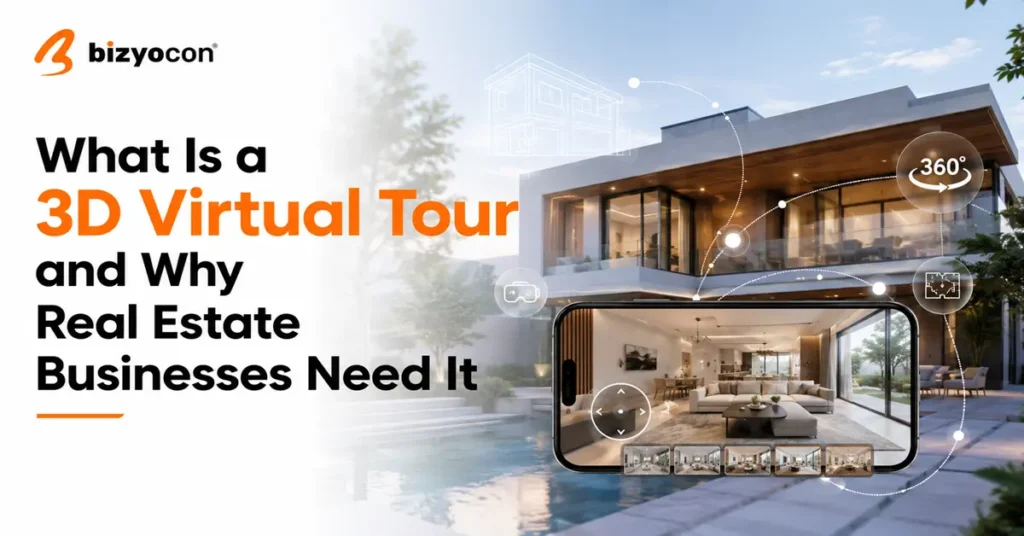
A 3D virtual tour is an interactive digital replica of a property, captured with a depth-sensing camera, that buyers can walk through on their own from any device – with a dollhouse view, floor plan and real measurements. Real estate businesses need one because it markets the layout rather than individual rooms: listings with 3D tours have been shown to sell up to 31% faster and at 4–9% higher prices, while cutting wasted showings by letting unsuitable buyers rule themselves out before they visit.
Photos sell a room. A 3D virtual tour sells the layout – and layout is the one thing buyers can’t judge from a listing, the thing that makes them drive across town to find out, and the thing that ends a deal at the front door when it turns out wrong.
Below: what the format actually is, how it’s built, how it compares to the alternatives, and the commercial case for putting one on every listing.
What Is a 3D Virtual Tour?
A 3D virtual tour is an interactive digital replica of a property that a buyer can walk through on their own, in any order, from any device. It’s built from depth data – the camera measures distance as well as colour – so the finished tour holds the property’s real dimensions, not just its appearance.
That geometry is what separates it from every other listing format, and it produces three features buyers genuinely use:
- Free navigation. Click from the hallway into the kitchen and back, at your own pace, instead of following someone else’s edit.
- Dollhouse view. An overhead 3D model of the whole floor, showing how rooms connect.
- Measurements and floor plans. Because dimensions are stored, a buyer can measure a wall or a doorway themselves – which is how relocating buyers check whether their furniture fits.
Be careful with the label. Plenty of listings advertise a “virtual tour” that’s really a photo slideshow or a 360 panorama, which is a different product entirely.
How Does a 3D Virtual Tour Work?
Three stages, and none of them involve a film crew.
1. Capture. A depth-sensing camera is placed on a tripod at a series of points through the property. Each position records a full 360° panorama plus distance data, usually via infrared or LiDAR. A 2,000 sq ft home takes roughly 60 to 100 scan positions, and Matterport puts a standard residential capture at 1.5 to 2.5 hours on site including setup.
2. Processing. The scans are stitched into a point cloud, then converted into a textured 3D mesh – a digital twin of the space. This is where the dollhouse view, the floor plan and the measurement tool come from. Processing typically runs overnight.
3. Delivery. The tour is hosted and delivered as a single embeddable link – added to your 99acres, Magicbricks or Housing.com listing, embedded on your own project page, and shared over WhatsApp or email. Most professional providers in India hand over a live link within 48 to 72 hours of the shoot.
3D Virtual Tour vs 360 Tour vs Video Walkthrough
These three get sold interchangeably. They’re not the same product, and the difference comes down to how much control the buyer gets.
| Format | What it captures | Buyer control | Floor plan & measurements | Typical cost |
| 3D virtual tour | Depth + colour → true 3D model | Walk anywhere, any order | Yes | ₹10,000–₹30,000 |
| 360 tour | Flat panoramas, no depth | Jump between fixed points | No | ₹5,000–₹15,000 |
| Video walkthrough | Linear footage | None – watch start to finish | No | ₹15,000–₹60,000 |
| Photo gallery | Stills | Click next | No | Bundled |
A 360 tour looks almost identical in a thumbnail and behaves very differently in use. It gives height and width but no depth, so the buyer hops between bubbles without ever forming a mental map of the floor.
Video is the better emotional format – paced, scored, and it works passively in a social feed. But it answers “what does this feel like,” not “where is everything.” Listings that perform best usually run both: property video for the scroll, 3D tour for the buyer who’s already interested and now wants to interrogate the layout.
Why Are 3D Virtual Tours Important in Real Estate?
Because buyer behaviour moved and most listings didn’t.
Property search in India now starts online and stays online far longer than it used to. NRI and out-of-state buyers shortlist entirely from a phone, and the scale of the market means a Gujarat or Mumbai project is competing for attention with hundreds of others on the same portal page. The listings that survive that shortlist are the ones that answer questions instead of raising them. A gallery of twelve beautiful photos raises questions: how far is the kitchen from the living area, is there a corridor between them, where does that door go?
The supply side hasn’t caught up. International benchmarking backs this – a study of 25,000 listings found 94% had no genuine virtual tour while 58% of buyers wanted one, and anyone who has scrolled 99acres or Magicbricks knows Indian inventory sits at a similar ratio. Documented demand, unmet by nine listings out of ten.
There’s a second effect that doesn’t show up in marketing metrics at all. A 3D tour front-loads qualification: buyers who would have walked in and immediately disliked the layout now filter themselves out at home. You get fewer viewings and better ones. For teams running high listing volumes, that saved time is often worth more than the price lift.
How 3D Virtual Tours Affect Sale Speed and Price
The sales effect is documented well enough to argue on numbers rather than instinct.
India doesn’t yet have a published listing-level study on this, so the hard numbers come from international datasets – but the buyer behaviour they measure is the same one driving Indian portal traffic.
An analysis of 143,575 listings across four markets found properties with 3D tours sold up to 31% faster in the strongest market and 9% faster on average, closing at prices 4–9% higher. A separate matched study of 700 listings – 350 with tours, 350 without – found a 4.8% price lift and roughly 20% fewer days on market. Portal-side engagement data points the same way: listings with interactive 3D tours draw substantially more page views, saves and shares than comparable listings without one.
Vendor data has an obvious interest, so discount it. But independent datasets agreeing on both speed and price is a consistent signal, and the direction of the effect has never been seriously disputed.
Which Real Estate Businesses Benefit Most?
The value lands differently depending on what you sell.
Agents and brokerages win listings with it before they market with it. Arriving at a pitch with a tour, floor plan and video attached to the fee is a materially different conversation than competing on commission.
Developers and under-construction sales teams scan one finished sample flat and market every unit on that floor plan across the tower – one capture, dozens of units. For buildings that don’t exist yet, a clearly labelled CGI walkthrough does the same job, and labelling it properly also keeps you on the right side of RERA advertising norms on misleading project imagery.
Property managers and rental operators cut escorted viewings for tenants who were never going to take the unit. In high-turnover portfolios that’s hours of staff time per week, which is an operating cost, not a marketing one.
Commercial and industrial agents get the most literal value: a tenant fitting out an office or warehouse wants column spacing, ceiling height and clear span, and a measurable digital twin answers all three without a site visit.
How Much Does a 3D Virtual Tour Cost, and Is It Worth It?
In the Indian market, professional capture for a 2BHK or 3BHK apartment typically runs ₹10,000–₹30,000 per tour, with ₹15,000 a common quote in Ahmedabad, Surat, Mumbai and the NCR. Providers who price by area charge roughly ₹25–₹50 per sq ft, which is the more sensible basis for showrooms, offices and villas. Premium cinematic 4K tours with drone footage and branded intros start nearer ₹50,000, and enterprise-scale capture of plants, hotels or large commercial floors is quoted per capture day – around ₹1,50,000 for a full day covering 500+ scan positions.
Three costs get missed at quoting stage: hosting (tours are hosted, not delivered as a file – roughly ₹1,500–₹2,000 per month per active tour, though many Indian studios bundle the first year), add-ons like floor plans, drone shots and video flythroughs at ₹5,000–₹15,000 each, and re-scans, because a repaint or a furniture change means scanning again rather than editing.
On buying your own camera: professional depth-capture hardware lands in India at around ₹5–6 lakh after duties, so it only makes sense past roughly 8–10 properties a month. Below that, outsourcing wins on cost and on consistency – good tours come from scan spacing and lighting, which is craft, not equipment.
Set that against the outcome. On a ₹1 crore flat, even a conservative 2% price effect is ₹2 lakh. A ₹15,000 tour doesn’t need to work often to pay for itself. The one case where it’s genuinely hard to justify is low-ticket rental stock in a tight local market, where units let from photos inside a week.
How to Get a 3D Virtual Tour Done
Five steps, start to live link:
- Prep the property properly. 3D capture is unforgiving – every cable, bin and stack of paperwork is preserved permanently in three dimensions.
- Fix the lighting. Blinds open in one room and closed in the next produces exposure jumps that read as low quality.
- Book the scan. Half a day on site covers most homes, including setup.
- Check ownership terms before you commission. Some platforms lock the finished model to their ecosystem, so you can’t embed or export it elsewhere.
- Publish it everywhere. Portal listings on 99acres, Magicbricks and Housing.com, embedded high on your own project page, in WhatsApp and enquiry replies, and as a short screen-recorded clip for paid and social – that last one costs nothing extra once the tour exists.
The 3D virtual tour has stopped being a differentiator and started becoming the baseline buyers expect. With AI-assisted capture now producing true 3D output from consumer 360 cameras, the cost of meeting that expectation keeps falling – which means the listings without one will stand out for the wrong reason.
FAQ
1. Can I make a 3D virtual tour with my phone?
You can make a basic one – smartphone capture apps stitch panoramas into a walkable tour, and it’s fine for a low-ticket rental. What a phone can’t record is depth, so you lose the dollhouse view, the auto floor plan and on-screen measurements. For a resale flat or a developer’s sample unit, a 360 camera or a professional depth camera is the minimum worth publishing.
2. Can furniture be added to an empty flat inside a 3D virtual tour?
Yes – virtual staging can be applied inside the tour, which matters in India where most resale and new-possession flats are handed over bare. Two rules: keep the staging label visible on screen, and never let it hide a defect, a beam or an odd room shape. An undisclosed staged tour becomes a misrepresentation problem the moment the buyer walks in.
3. Do buyers need a VR headset or an app to view a 3D virtual tour?
No. It opens as a normal link in any mobile or desktop browser, which is why it forwards so well on WhatsApp. A VR headset is optional and adds immersion, but almost no Indian buyer uses one – assume the tour will be viewed on a phone over mobile data and ask your provider to optimise the load size accordingly.
4. What happens to the tour if I stop paying the hosting fee?
The link stops working. Tours are hosted on the provider’s platform, not delivered as a file you keep, so a lapsed subscription takes the tour offline and breaks every portal listing, email and WhatsApp forward pointing at it. Before signing, ask two things: who holds the account, and whether you can transfer the tour to your own account later.
5. Can I add my branding and contact details inside a 3D virtual tour?
Yes, and most agencies underuse this. You can place your logo on the loading screen, drop clickable tags on features worth explaining – modular kitchen brand, balcony view direction, parking allotment – and attach an enquiry form or WhatsApp button inside the tour itself. That turns the tour from a viewing tool into a lead-capture asset that works while your sales team is asleep.