
GEO and SEO are not rivals in 2026 – they are two halves of the same visibility strategy. SEO gets your content discovered, indexed, and ranked in traditional search; GEO (Generative Engine Optimization) gets that same content cited inside AI-generated answers on ChatGPT, Google AI Overviews, Perplexity, and Gemini. The idea that one has “killed” the other is the single biggest myth of the year – the facts tell a very different story.
A lot of noise online claims SEO is dead, that keywords no longer matter, or that you only need to “optimize for AI” now. None of that holds up when you look at how AI engines actually work: they still crawl, read, and pull answers from indexed web pages. So a page with weak technical SEO simply never enters the pool AI can quote from. At the same time, brands that ignore GEO are watching competitors get name-dropped in AI answers while their own well-ranked pages go unmentioned.
In this article, we’ll separate the myths from the facts – busting the most common misconceptions about GEO vs SEO, showing exactly where the two overlap and where they genuinely differ, and giving you a clear picture of what actually drives visibility in 2026. No hype, just what’s working now.
SEO vs GEO in 2026: Myths vs Facts
Let’s get the noisy claims out of the way first. Some of what’s floating around has real substance. Most of it is just oversimplified for clicks.
Myth: GEO is replacing SEO completely. Fact: GEO is really an extension of SEO, built for how AI tools read and summarize content. It doesn’t replace ranking on Google. It adds another visibility channel on top of what you’re already doing.
Myth: If you’re not doing GEO, you’re already behind. Fact: If your existing SEO content is well-structured, factual, and genuinely helpful, you’ve probably already covered most of what GEO asks for. You don’t need to start from scratch.
Myth: SEO traffic is disappearing because of AI search. Fact: Organic search is still driving significant traffic for most businesses. AI Overviews and chatbots added a new discovery layer on top of search, they didn’t remove the old one.
Myth: You should shift most of your budget from SEO to GEO. Fact: For nearly every business, SEO should stay the foundation. GEO practices get layered on top of that foundation, not swapped in for it.
Myth: Ranking #1 on Google doesn’t matter anymore. Fact: It still does, especially for commercial and comparison searches, where people are still clicking through and comparing before they buy anything.
Now that those are cleared up, let’s look at what GEO actually is, and how it fits alongside the SEO work you’re probably already doing.
What Is Generative Engine Optimization (GEO)?
GEO stands for Generative Engine Optimization. In simple terms, it’s about structuring your content so AI systems can:
- Understand it
- Trust it
- Pull from it when they write their own answers
These systems include tools like ChatGPT, Google’s AI Overviews, and Perplexity.
Traditional SEO is mostly about ranking a page on a results list. GEO is a bit different. It’s about getting your brand, product, or expertise mentioned directly inside an AI-generated answer, even if the person never clicks through to your site at all. They just read the paragraph the AI put together, and either your business shows up in it, or it doesn’t.
This shift matters because the way people search is changing. More of them are just asking AI tools a direct question instead of typing a few keywords into Google and scrolling past ten blue links to find what they need.
GEO vs SEO: What’s the Difference in 2026?
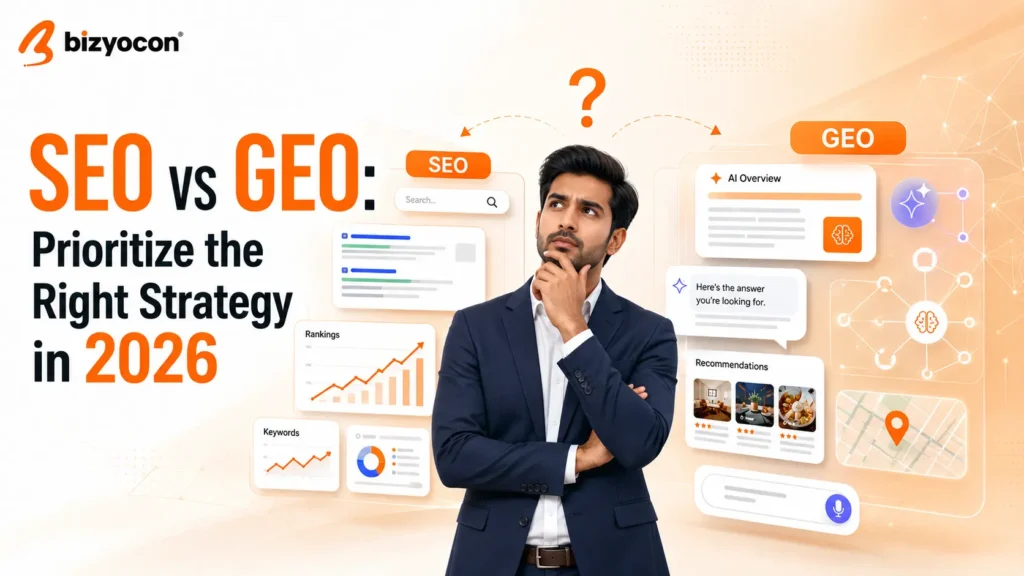
When people ask about GEO vs SEO 2026, they’re usually circling the same underlying question: with AI tools now sitting right alongside traditional search, where should the effort actually go? The simplest way to think about it is as two related disciplines that overlap a lot, not two competitors fighting for the same job.
| Parameter | SEO | GEO |
| What it optimizes for | A webpage’s position in search results | The likelihood of your content being pulled into an AI-generated answer |
| Where visibility shows up | Google’s Search Engine Results Page (SERP) | AI Overviews, ChatGPT, Perplexity, and other AI-powered search tools |
| What influences it most | • Backlink profile • Domain authority • On-page keyword usage • Site speed & technical health | • Source credibility • Content clarity & structure • Factual accuracy • Machine-readable formatting (schema, headings) |
| Ideal content format | Longer, keyword-optimized articles built around search intent | Short, fact-dense sections with a direct answer placed early |
| Common tracking tools | • Google Search Console • Ahrefs • SEMrush • Google Analytics 4 (GA4) | • Brand-mention trackers • AI citation monitoring tools • Manual prompt testing across AI platforms |
| Time to see results | Weeks to months, with steady, compounding gains | Can happen faster once indexed, but visibility may change as AI models update |
| Clearest sign of success | Higher rankings and more organic clicks | Being cited, quoted, or mentioned inside an AI-generated answer |
| Risk of ignoring it | Falling behind competitors in search rankings | Remaining invisible in AI-generated answers, even while ranking well on Google |
| Best suited for | Transactional and commercial searches where users compare before buying | Informational and question-based searches where users want quick, direct answers |
Both of these still rest on the same foundation, content that’s genuinely useful, well organized, and accurate. GEO isn’t throwing out SEO fundamentals. It’s building on them, then layering on something extra: a focus on how AI models actually parse and summarize what you’ve written.
Is GEO Replacing SEO in 2026?
No. Honestly, this is probably the biggest myth going around right now, so let’s just say it plainly.
Google is still handling an enormous volume of searches every day, and organic results still send a lot of traffic to most businesses. AI Overviews and chat-based tools have added a new layer to how people find information, but they haven’t torn down the search engine underneath it.
What’s really happening is more of an expansion of the search landscape than one system knocking out another. People now have a few different ways to get answers:
- Traditional Google search with organic listings
- AI Overviews sitting above those listings
- Standalone AI assistants like ChatGPT or Claude
- Voice and conversational search
Each of these works a little differently, and each needs its own kind of optimization. Ignore any one of them, and you’re leaving visibility on the table without really meaning to.
Is SEO Dead in 2026?
No, and honestly, this claim usually comes from people mixing up “SEO is changing” with “SEO is over.” Those are two very different things.
SEO has gone through plenty of changes before this one. Keyword stuffing died out. Link farms died out. Thin, low-effort content died out too. Every time, someone declared SEO dead, and every time, it just quietly turned into a more refined version of itself.
Here’s what’s still true in 2026:
- Technical SEO still matters for both search engines and AI crawlers, covering things like:
- Site speed
- Mobile usability
- Crawlability
- Content quality and topical authority still decide whether you rank and whether you get cited.
- Backlinks and brand mentions still signal trust, both to Google and to AI models.
And here’s what’s shifting:
- AI Overviews can cut into click-through rates for some informational queries, since people already have their answer without visiting a website.
- Structured, easy-to-extract content tends to perform better across both search and AI answers.
- Brand authority and a consistent presence online are starting to matter more for AI citation likelihood too.
So instead of asking who wins in the SEO vs GEO comparison, it’s more accurate to say SEO is simply evolving to include GEO as part of itself. That’s the real answer to whether SEO is evolving or dying in 2026, it’s absorbing new requirements, not disappearing.
How Does AI Search Affect SEO in 2026?
AI search tools pull from the same indexed web content search engines already use, but instead of just listing links, they summarize and synthesize it into an answer. A question that comes up a lot here is whether AI Overviews will end up killing organic traffic altogether. The more realistic picture is a shift in where that traffic comes from, not a total loss of it. In practice, this plays out in a few ways for businesses:
Fewer clicks for simple informational queries. If someone asks “what is GEO,” an AI tool might just answer it on the spot, and there’s less reason for them to click through to a blog post.
More clicks for comparison and decision-stage queries. People still want to read full articles, weigh their options, and go deeper before they actually make a purchase decision.
New visibility opportunities. Even without a click, getting your brand mentioned inside an AI answer builds recognition and trust, not unlike getting name-dropped in a publication people already trust.
Increased importance of clarity. AI models tend to favor content that answers a question directly, uses clear headings, and skips the vague, overly promotional language.
Do I Need GEO If I Already Do SEO?
If your content is already well-structured, accurate, and genuinely useful, you’ve probably built most of the foundation GEO needs without even trying. The extra work usually comes down to a few things:
- Structuring answers clearly, often near the top of a section, before getting into the finer details
- Using specific, factual language instead of vague marketing claims
- Keeping your site’s technical markup clean so AI crawlers can actually parse it
- Building real authority signals, like accurate author information and a consistent, factual publishing history
You don’t need to throw out your existing SEO work. You just need to build on it a bit further.
SEO vs GEO: Which Should I Prioritize in 2026?
The right answer depends on your business and how your audience actually searches, but here’s a practical approach that works for most companies:
- Keep your SEO foundation strong. Still the biggest driver of your traffic today, thanks to:
- Solid technical health
- On-page optimization
- Good, well-researched content
- Layer GEO practices on top. Structure your key pages so answers are easy to pull out, and make sure the most important facts show up clearly, early on.
- Monitor both traffic and citations. Keep tracking your organic rankings like usual, but also start paying attention to whether your brand shows up in AI-generated answers for relevant queries.
- Avoid shifting your entire budget. Should you shift budget from SEO to GEO? For most businesses, no. GEO adds to what you’re doing, it isn’t a replacement line item. Putting some of your content and technical effort toward AI-friendly structuring makes sense. Walking away from channels that already work for you doesn’t.
Where Does AEO Fit In?
You’ll probably also run into the term AEO (Answer Engine Optimization) somewhere in the AEO vs GEO vs SEO conversation. The short version: SEO ranks pages, AEO optimizes content to directly answer specific questions (handy for voice search and featured snippets), and GEO focuses on getting content cited inside AI-generated, conversational answers. In practice, these three overlap quite a bit, since content that answers a question clearly tends to do well across all of them anyway.
What Metrics Matter for GEO vs SEO?
The usual SEO metrics still apply here:
- Organic traffic
- Keyword rankings
- Click-through rate
- Conversions coming from organic search
For GEO, businesses are starting to keep an eye on a slightly different set:
- How often your brand gets mentioned in AI-generated answers
- Whether your content actually gets cited as a source when relevant questions come up
- Referral traffic from AI tools that do include links
- Overall brand visibility across AI platforms, even when there’s no click involved
These metrics are still fairly new and maturing as the tools themselves improve, so treat them more as directional signals for now than exact benchmarks.
How to Make Content SEO and GEO Friendly in 2026
A handful of habits go a long way toward helping content perform well across both search engines and AI tools:
- Lead with a clear, direct answer before adding the supporting detail
- Use descriptive headings that actually match how people phrase their questions
- Back up your claims with specific, verifiable information instead of vague statements
- Keep the technical SEO basics in place:
- Fast load times
- Clean site structure
- Mobile-friendly design
- Update your content regularly so it stays accurate as facts and tools keep changing
Do this well, and your content ends up working for both a person scanning a results page and an AI model trying to summarize an answer.
Does Ranking #1 on Google Still Matter in 2026?
Yes, for a lot of query types, it really does. High rankings still drive strong click-through rates, especially for commercial and transactional searches, where people are actively comparing options before they buy.
What’s changed is that ranking #1 isn’t the only visibility goal worth chasing anymore. Showing up inside an AI-generated answer, essentially a position zero on a completely different kind of interface, is now something worth working toward alongside it.
Final Thoughts
The SEO vs GEO debate makes for a catchy headline, but it oversimplifies what’s actually going on. Search is expanding into more formats, not narrowing down to one winner. Businesses that adjust their content strategy to work for both traditional search engines and AI-driven answers are the ones who’ll have the strongest visibility through the rest of 2026 and beyond.
FAQs
1. Is GEO completely replacing SEO in 2026?
No. GEO adds a new visibility layer for AI-generated answers, but organic search still drives most traffic for businesses. Think of GEO as an extension of SEO, not a replacement – you need both working together, not one instead of the other.
2. How much budget should I move from SEO to GEO?
Most businesses shouldn’t move a large chunk. SEO should stay your foundation since it still drives the bulk of organic traffic. A smaller portion of your content and technical effort can go toward GEO practices, layered on top rather than replacing existing SEO spend.
3. Will my Google ranking suffer if I focus on GEO?
No, as long as you don’t neglect core SEO fundamentals. GEO practices – clear structure, factual accuracy, direct answers – actually support good SEO too. The two disciplines share the same foundation, so improving one rarely hurts the other.
4. How long does it take to see GEO results compared to SEO?
SEO typically takes weeks to months of steady work before rankings improve. GEO can show visibility faster once your content gets indexed and cited, but that visibility can shift quickly as AI models update, unlike the more stable, compounding nature of SEO gains.
5. Do I need separate content for GEO, or can I reuse my SEO content?
You can reuse most of it. If your SEO content is already accurate, well-structured, and genuinely useful, it likely meets most GEO requirements already. Minor adjustments – clearer headings, direct answers near the top – usually do the job.
6. Is FAQ or AEO content part of GEO strategy?
Yes. FAQ-style, question-based content aligns closely with how AI tools pull and cite information. It sits at the overlap of AEO and GEO, since direct, well-labeled Q&A content tends to get extracted into AI-generated answers more easily than long, narrative paragraphs.