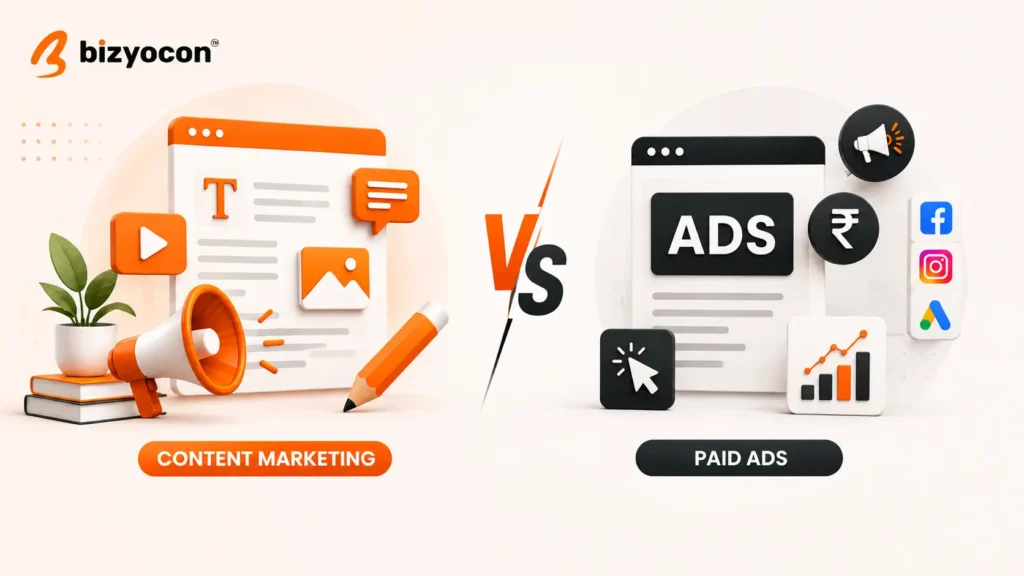
If you run a small business in India and have a limited marketing budget, you’ve probably faced this exact dilemma: should you invest in content marketing or pour money into paid ads? Both promise growth. Both eat into your budget. And both work very differently.
This guide breaks down the real trade-offs so you can decide where your money goes, based on your goals, your timeline, and how much you can actually afford to spend.
Content Marketing vs Paid Ads: The Core Difference
The main difference between content marketing and paid marketing is timing and ownership. Content marketing builds an asset you own that compounds over time, while paid ads rent attention that stops the moment you stop paying.
With content marketing, you create blogs, videos, guides, and social posts that attract customers organically through search and sharing. The traffic builds slowly but keeps working long after publishing. Paid advertising – Google Ads, Meta ads, or sponsored listings – buys you instant visibility, but the moment your budget runs out, the leads dry up.
Think of it this way. Content marketing is like buying a shop. Paid ads are like renting a billboard by the day.
Comparing Marketing Techniques: Content vs Advertising
When you put content marketing compared to paid ads side by side, the contrast becomes clear across a few practical factors.
| Factor | Content Marketing | Paid Ads |
| Speed of results | Slow (3–6 months) | Immediate |
| Cost over time | Lower long-term | Recurring, rises with competition |
| Longevity | Compounds, lasts years | Stops when budget stops |
| Trust building | High | Moderate |
| Best for | Sustained growth | Quick sales, launches |
This is the heart of any marketing techniques comparison for small enterprises. Content promotion versus advertising isn’t about one being better – it’s about what each does well. Paid campaigns are predictable and fast. Content strategy is patient and cumulative.
Video marketing sits across both. A video can be organic content (a YouTube tutorial that ranks for years) or a paid asset (a skippable ad). So content marketing vs video marketing isn’t really a fair comparison – video is a format that lives inside either approach.
Benefits of Content Marketing Over Paid Ads
The biggest benefit of content marketing over paid ads is that it keeps generating leads without ongoing spend, building trust and authority that advertising alone can’t buy.
Here’s what content gives you that ads don’t:
- Lasting value. A well-ranked blog can bring traffic for years. An ad disappears the day you pause it.
- Trust and credibility. People research before they buy. Helpful content positions you as an expert, not just a seller.
- Lower cost per lead over time. Upfront effort is high, but the cost per acquisition tends to fall as your library grows.
- SEO and AI visibility. Quality content gets pulled into Google search and AI-generated answers, putting your brand in front of buyers actively looking.
The catch is patience. Content marketing ROI for Indian startups usually takes a few months to show, which is hard when you need sales now.
When to Use Content Marketing Instead of Paid Ads
Use content marketing instead of paid ads when you’re building a long-term brand, your customers research before buying, and you can wait a few months for results. Choose paid ads when you need fast leads, are launching something time-sensitive, or are testing a new market.
Most small businesses in India don’t have to pick just one. A practical middle path looks like this:
- Early stage, need cash flow fast: Lean on paid ads to generate immediate leads while you build your content base.
- Stable but want to cut costs: Shift budget gradually toward content so you’re less dependent on rising ad costs.
- Established and scaling: Run both – content for trust and organic reach, ads for targeted pushes during launches or sales.
The smartest online advertising methods often work because good content backs them up. A paid ad that sends people to a weak landing page wastes money. The same ad pointing to a useful resource converts far better.
Marketing ROI for Small Businesses: How to Actually Measure It
To measure marketing ROI for small businesses, compare what you spend against the revenue each channel brings in over a realistic time window – not just immediate clicks.
The common mistake is judging content marketing on the same short timeline as paid ads. Paid campaigns show ROI in days or weeks. Content shows its return over months and years. Measuring both the same way makes content look weak when it’s actually still warming up.
For a fair picture, track:
- Paid ads: cost per click, cost per lead, return on ad spend (ROAS).
- Content marketing: organic traffic growth, leads from search, and how long published pieces keep performing.
A blog written once that brings leads for two years has a very different ROI profile than an ad that needs constant funding. Both belong in a serious digital marketing strategy – they just earn their keep differently.
Common Mistakes Small Businesses Make
A few avoidable errors waste budget on both sides:
- Expecting content to work overnight. It won’t. Treat it as an investment, not a quick fix.
- Running ads with no clear offer. Traffic without a strong reason to act just burns money.
- Ignoring one channel completely. Pure ad dependence leaves you exposed to rising costs. Pure content leaves short-term sales on the table.
- Not tracking results. If you don’t measure, you can’t tell which rupee is working.
The Bottom Line
For most small businesses in India, the answer to content marketing vs paid ads isn’t either-or. Paid ads give you speed; content marketing gives you staying power. The best returns usually come from using ads to drive early momentum while steadily building content that lowers your dependence on paid spend over time.
If you’re short on budget, start with whichever solves your most urgent problem – fast leads or long-term trust – and add the other as you grow.
At Bizyocon, we help small businesses and startups build marketing strategies that balance both, so your budget works harder and your growth doesn’t stop the moment the ad spend does. If you’re weighing where to invest next, that’s a conversation worth having.
FAQs
1. What is the difference between content marketing and paid marketing?
Content marketing attracts customers organically through valuable content like blogs and videos that keep working over time, while paid marketing buys instant visibility through ads that stop delivering once you stop paying. Content builds an owned asset; ads rent attention.
2. What are the benefits of content marketing over paid ads?
Content marketing keeps generating leads without ongoing spend, builds long-term trust and authority, lowers cost per lead over time, and improves your visibility in search and AI-generated answers. Its main drawback is that results take a few months to appear.
3. When should I use content marketing instead of paid ads?
Use content marketing when you’re building a long-term brand, your customers research before buying, and you can wait a few months for returns. Use paid ads when you need immediate leads, are running a time-sensitive launch, or are quickly testing a new market.
4. What is the difference between content marketing and advertising?
Advertising is a paid method to push a message to a target audience for as long as you fund it. Content marketing is a strategy that earns attention by being genuinely useful, and the assets you create continue working without repeated payment.