
Google Ads is better when you need leads quickly, want to test demand or are promoting a time-limited offer, because traffic stops the moment you stop paying. SEO is better for building lower-cost, long-term traffic that keeps working after the initial investment, but it typically takes several months to show results. For most growing businesses, the best answer to SEO vs Google Ads is both: ads for immediate demand, SEO for compounding growth.
Every business that wants customers from Google faces the same choice: pay for visibility now, or earn it over time. The answer shapes your marketing budget, your cash flow and how quickly you grow.
This guide explains the difference between SEO and Google Ads using current data, Indian cost ranges and a worked ROI model. It’s written by the team at Bizyocon, a digital marketing agency in Gandhinagar that runs both SEO and Google Ads campaigns. We sell both services, so we have tried to show honestly where each one wins and where it doesn’t.
Understanding SEO
What Is SEO?
Search engine optimisation (SEO) is the process of improving your website so it ranks higher in Google’s unpaid, organic results. It covers four main areas:
- Technical SEO: Site speed, mobile usability, crawlability and structured data
- On-page SEO: Content, headings, keywords and internal links that match what people search for
- Off-page SEO: Backlinks, mentions and reviews that build authority
- Local SEO: Google Business Profile, local citations and reviews for “near me” searches
Benefits of SEO for Businesses
- No cost per click: You don’t pay Google for each visitor.
- Compounding traffic: Good content can keep ranking and attracting visitors for years.
- Trust and credibility: Many users trust organic results more than ads.
- Wider reach: One strong page can rank for hundreds of related searches.
- Visibility in AI answers: Well-structured, authoritative content is more likely to be cited in AI Overviews and AI assistants.
Long-Term vs Short-Term Results
SEO is a long-term strategy. Most businesses start to see meaningful movement in 3–6 months, and competitive keywords can take a year or more. Results then tend to build on each other, because each ranking page strengthens the site’s overall authority.
How fast SEO works depends on:
- Domain age and authority: New sites usually take longer.
- Competition: Local service keywords often move faster than national ones.
- Content quality: Pages that fully answer a searcher’s question rank better.
- Technical health: Slow or poorly structured sites hold rankings back.
- Consistency: Regular publishing and link building speed up growth.
Understanding Google Ads
What Is Google Ads?
Google Ads is Google’s pay-per-click (PPC) advertising platform. You bid on keywords, and your ads appear above or below organic results, as well as across YouTube, Gmail and partner sites. You pay only when someone clicks. That’s why SEO vs PPC is often used to mean the same comparison.
Benefits of Google Ads for Businesses
- Immediate visibility: Ads can start showing within hours of approval.
- Precise targeting: You can target by keyword, location, device, time of day and audience.
- Full control: You can raise, lower or pause spend at any time.
- Fast testing: You can learn which keywords, offers and messages convert before investing in SEO.
- Clear measurement: Clicks, conversions and cost per lead are tracked directly.
What Clicks Cost in India
Cost per click (CPC) varies widely by industry. Based on Google Keyword Planner data for India compiled by Nico Digital (June 2026):
| Industry | Typical CPC range (₹) |
|---|---|
| Insurance | 310–460 |
| Education | 295–385 |
| B2B SaaS / tech | 205–255 |
| Healthcare | 95–210 |
| Real estate | 50–330 |
| Legal | 50–130 |
| Home services | 25–75 |
| Ecommerce / retail | 3–20 |
Indicative ranges for broad commercial keywords. Your actual CPC depends on city, competition, keyword intent and Quality Score.
For context, WordStream’s US benchmarks (April 2025–March 2026), summarised by Search Engine Journal, report an average CPC of $5.42, a conversion rate of 8.18% and a cost per lead of $66.69.
SEO vs Google Ads: Key Differences
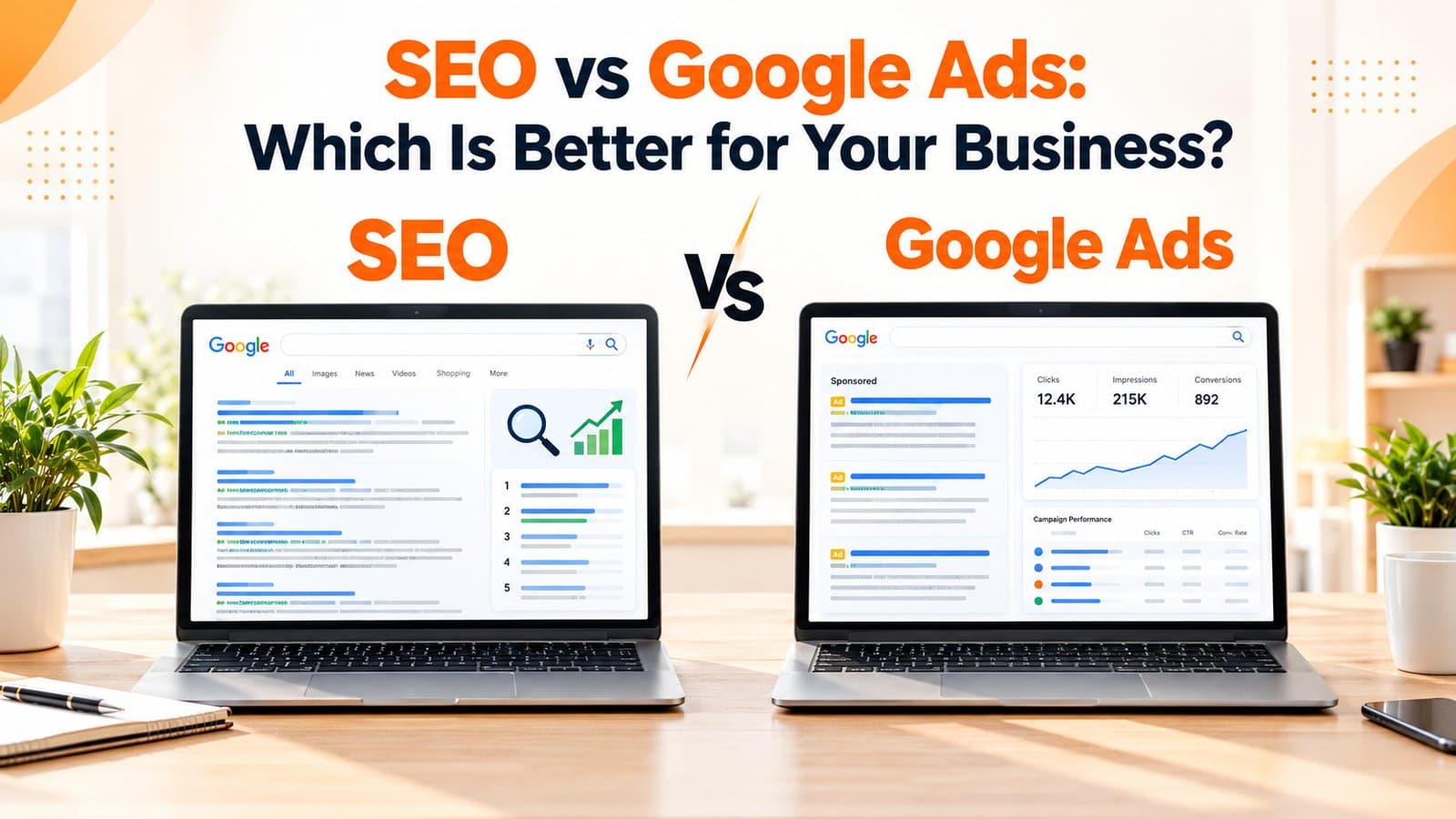
The main difference between SEO and Google Ads is how you pay for visibility. With Google Ads you pay for every click, and traffic stops when spending stops. With SEO you invest in content and authority, and traffic can continue without a per-click cost.
| Factor | SEO | Google Ads |
|---|---|---|
| Time to results | Usually 3–6+ months | Hours to days |
| Cost model | Content, technical and link work; no per-click fee | Pay per click plus management |
| Traffic when you stop investing | Declines slowly | Stops immediately |
| Targeting control | Limited to the keywords you rank for | Precise: keyword, location, time, audience |
| Trust | Often higher for organic results | Clearly labelled as ads |
| Best for | Long-term, compounding growth | Fast leads, testing and promotions |
| Scalability | Limited by rankings and content | Limited by budget and search volume |
SEO vs Google Ads Cost
The SEO vs Google Ads cost comparison isn’t simply “free vs paid”.
- Google Ads costs: Ad spend (clicks × CPC) plus management fees and landing-page work. Costs scale directly with traffic.
- SEO costs: Content creation, technical fixes, link building and expert time, usually as a monthly retainer. Costs stay relatively fixed while traffic grows.
In the short term, Google Ads usually delivers cheaper first customers. Over 12–24 months, SEO often delivers a lower cost per customer, because each additional visit doesn’t cost extra.
SEO vs Google Ads ROI
ROI = (revenue from the channel − total cost of the channel) ÷ total cost × 100.
Worked example (illustrative assumptions): A service business sells at ₹25,000 per customer and closes 25% of leads.
Google Ads:
- ₹60,000 monthly ad spend + ₹15,000 management = ₹75,000 a month
- At ₹150 CPC: 400 clicks → 32 leads (8% conversion) → 8 customers → ₹2,00,000 revenue
- Monthly ROI: about 167%. Cost per customer: ₹9,375
SEO:
- ₹40,000 monthly retainer = ₹4.8 lakh a year
- Year 1: no customers in months 1–3, then growing from 1 to 9 customers a month (45 in total) → ₹11.25 lakh revenue, ROI about 134%
- Year 2: a steady 9 customers a month (108 in total) → ₹27 lakh revenue, ROI about 463%. Cost per customer: about ₹4,444
| Measure | Google Ads (any year) | SEO year 1 | SEO year 2 |
|---|---|---|---|
| Annual cost | ₹9 lakh | ₹4.8 lakh | ₹4.8 lakh |
| Customers | 96 | 45 | 108 |
| Revenue ROI | ~167% | ~134% | ~463% |
| Cost per customer | ₹9,375 | ~₹10,667 | ~₹4,444 |
These are illustrative numbers. ROI here is based on revenue; use gross profit for real decisions, and replace the assumptions with your own CPC, conversion rate and close rate.
The pattern is typical: Google Ads wins early, and SEO wins over time once rankings compound.
Google Ads vs Organic SEO: Traffic Generation
Google Ads gives you traffic you can switch on, scale and target precisely. Organic SEO gives you traffic that builds slowly but keeps flowing.
AI search is changing both. An Ahrefs study of 300,000 keywords found a 58% lower average click-through rate for the top-ranking page when an AI Overview appeared (December 2025 data, published February 2026). Seer Interactive found that on informational queries with AI Overviews, organic CTR fell 61% and paid CTR fell 68% between June 2024 and September 2025. Brands cited in AI Overviews earned more clicks than those that weren’t.
The lesson: aim for commercial keywords where buyers still click, and structure your content so AI systems can cite it.
SEO vs Google Ads for Business: Longevity and Sustainability
- Google Ads: Results last as long as your budget. Rising CPCs can squeeze margins over time.
- SEO: Rankings are an asset that can keep producing leads, though they need maintenance as competitors and algorithms change.
For long-term SEO vs Google Ads for business planning, think of ads as renting traffic and SEO as owning it.
How to Measure Each Channel
| Metric | SEO | Google Ads |
|---|---|---|
| Visibility | Rankings, impressions (Search Console) | Impressions, impression share |
| Traffic | Organic sessions (GA4) | Clicks, CTR |
| Efficiency | Cost per organic lead | CPC, cost per conversion |
| Outcome | Leads, sales, revenue from organic | Conversions, ROAS, revenue |
| Leading indicators | New keywords ranking, backlinks | Quality Score, search term relevance |
Set up conversion tracking in GA4 and Google Ads before you start, so both channels are judged on leads and revenue, not just traffic.
SEO or Google Ads: Which Is Better for Your Business?
There is no universal winner. The right choice depends on your budget, timeline and goals.
Choose by Situation
| Your situation | Best starting point | Why |
|---|---|---|
| New business that needs leads this month | Google Ads | Immediate traffic and data |
| Limited budget, can wait 6+ months | SEO | Lower long-term cost per lead |
| Seasonal sale or event | Google Ads | Time-bound visibility |
| High-value services with long research cycles | Both | Ads capture demand; SEO builds trust |
| Local business (clinic, salon, showroom) | Local SEO + Google Ads | “Near me” searches convert well |
| Ecommerce with many products | Both, with Shopping ads | Product listings plus category SEO |
| Very high-CPC industry | SEO-led, with focused ads | Paid clicks get expensive at scale |
Key Factors to Weigh
- Budget: Google Ads needs ongoing spend; SEO needs consistent investment over months.
- Timeline: Need results in weeks? Start with ads. Planning for next year? Start SEO now.
- Goals: Lead generation, brand authority, sales or local footfall each favour a different mix.
- Competition: Strong competitors in organic results may mean SEO takes longer.
- Margins: High-margin products can absorb higher CPCs.
- Internal resources: SEO needs content and technical work; ads need landing pages and active management.
A Phased Budget Plan
Many businesses use a simple phased approach:
- Months 1–3: Put most of the budget into Google Ads for immediate leads, while fixing technical SEO and publishing core service pages.
- Months 4–9: Keep ads on your best-converting keywords, and grow SEO content and local SEO using what the ads have taught you.
- Months 10 onwards: As organic rankings and leads grow, reduce ad spend on keywords you rank for, and reinvest in new keywords, remarketing or expansion.
Common Mistakes to Avoid
- Judging SEO after six weeks: Most SEO work needs months to show results.
- Sending ads to the homepage: Dedicated landing pages convert far better.
- Tracking clicks, not revenue: Cheap clicks that never convert are expensive.
- Stopping SEO once rankings arrive: Competitors keep publishing, and rankings fade without maintenance.
- Bidding on broad, low-intent keywords: Wasted spend adds up quickly.
How SEO and Google Ads Work Better Together
- Use Google Ads search term data to find keywords that convert, then target them with SEO content.
- Use SEO landing pages to improve ad Quality Score and lower CPC.
- Show up twice on important searches, in both an ad and an organic result, to build trust.
- Reduce ad spend gradually on keywords where you rank well organically.
- Retarget organic visitors with Display and YouTube ads.
Conclusion
The SEO vs Google Ads decision comes down to speed versus sustainability. Google Ads delivers fast, controllable traffic at a per-click cost. SEO builds an asset that lowers your cost per customer over time. Most businesses grow fastest by starting ads for immediate demand while investing in SEO for the long term, and then shifting budget as organic results mature.
Whichever you choose, track leads and revenue, not just clicks, so every rupee is measured. Review the results every quarter and move budget towards the channel that delivers the lowest cost per customer.
Not sure which mix suits your business? Explore our SEO services and Google Ads management services, or request a free proposal and we’ll recommend a plan based on your budget and goals.the right mix for your business.
Frequently Asked Questions
Google Ads charges per click and delivers immediate traffic that stops when you stop paying. SEO earns organic rankings over months, with no per-click cost and traffic that can last for years.
Google Ads is usually more cost-effective in the first few months. Over 12–24 months, SEO often delivers a lower cost per customer, because traffic grows without extra click costs.
Use ROI = (revenue − cost) ÷ cost × 100. Track conversions in Google Analytics 4 and Google Ads, attribute leads and sales to each channel, and include all costs: ad spend, management fees and SEO retainers.
Yes, and most businesses should. Ads bring immediate leads and keyword data, while SEO lowers long-term costs and builds trust.
If you need customers now, start with focused Google Ads on high-intent keywords. If you can wait, invest in local and on-page SEO. Many small businesses do both on a modest budget.
Google Ads can bring traffic within hours. SEO usually takes 3–6 months to show meaningful results, and longer for competitive keywords.
No. Google states that advertising doesn’t influence organic rankings. Ads can, however, reveal which keywords convert, which helps your SEO strategy.
Start with a budget that buys enough clicks to learn. For example, at a ₹150 CPC, ₹30,000 a month buys about 200 clicks. Scale up once you know your cost per lead.
Not entirely. Reduce spend on keywords where you rank strongly, but keep ads for new offers, competitive terms and remarketing.
Yes, but the approach is changing. Focus on commercial keywords, structure content so it answers questions clearly, and build authority so AI systems cite your brand.