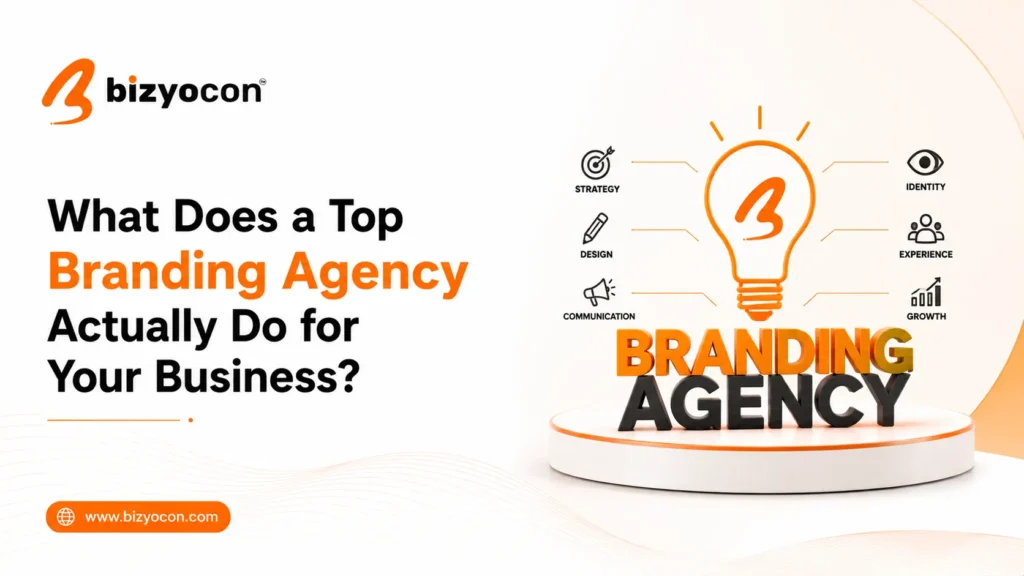
Most businesses know they need a stronger brand. Very few know what that work actually involves or what to expect when they hire a top branding agency to deliver it. If you have ever paid a designer for a logo and wondered why sales never changed, this guide is for you. A logo is not a brand. A brand is the co mplete system of strategy, identity, messaging, and customer experience that decides how people perceive and choose your business. A professional branding agency builds the entire system, not just a single visual asset. In this guide, we explain in detail what a branding company does, how the process works, the measurable results, and how to choose the best branding agency for your goals.
What Is a Branding Agency?
A branding agency is a specialized branding company that researches, defines, designs, and manages how a business is perceived in its market. It combines brand consultants, strategists, designers, and copywriters under one roof to build a complete brand system. This is different from a general marketing agency. A marketing agency focuses on campaigns, ads, and lead generation activities that create demand today. A brand strategy agency focuses on the foundation below those campaigns: brand positioning, identity, voice, and guidelines. When the campaign budget stops, the brand is what customers still remember. Think of it this way: marketing makes people notice you; branding makes people trust you and come back. A creative branding agency makes sure both happen regularly. A strong branding partner also protects long-term brand equity, the measurable commercial value of being noted and preferred. That is why established businesses treat branding services as an investment, not a design expense.
What Does a Top Branding Agency Actually Do?
The work of a professional branding agency typically spans five core service areas. Here is what each one actually involves:
1. Brand Strategy
Everything starts with strategy. Brand consultants run stakeholder interviews, customer research, market analysis, and competitor audits to answer three questions: Who are you for? Why should they choose you? What should they remember about you?
The output is a brand strategy document covering brand positioning, target audience segments, value proposition, brand personality, and brand architecture (how your products or sub-brands relate to each other). Every design and messaging decision later flows from this document; that is what separates a brand strategy agency from a freelance designer working on instinct.
2. Brand Identity Design
This is the visual layer most people associate with branding. Brand identity design includes the logo system, color palette, typography, iconography, photography style, packaging design, and overall visual language.
A top branding agency designs identity as a system, not a single mark, meaning your brand looks consistent on a business card, a website, a trade-show banner, and an Instagram reel. Consistency is what builds recognition, and recognition is what builds trust.
3. Brand Messaging and Voice
Visuals attract attention; words convert it. Brand messaging work includes your tagline, brand story, elevator pitch, tone of voice, and a messaging framework your sales and marketing teams can reuse.
A creative branding agency documents how your brand speaks, formal or friendly, technical or simple, so every email, ad, proposal, and social post sounds like it’s from the same company. For B2B businesses, clear brand messaging often shortens sales cycles because buyers immediately understand what you do and why it matters.
4. Brand Guidelines
Brand guidelines are the rulebook that keeps everything consistent as you grow. A good brand book documents logo usage, spacing, color codes, typography rules, voice and tone, do’s and don’ts, and template systems.
Without guidelines, brands slowly fall apart; every new vendor, employee, or agency interprets the brand differently. With guidelines, you can scale across teams, locations, and channels while staying recognizable. This single deliverable often determines whether your branding investment lasts two years or twenty.
5. Brand Management and Rollout
The best branding agency does not disappear after handing over files. Rollout services include launch planning, website and collateral updates, internal brand training, asset libraries, and periodic brand audits.
For companies undergoing rebranding services after a merger, a market shift, or a reputation problem, managed rollout is critical. A rebrand that never fully ships confuses customers more than the old brand did.
How Does a Branding Agency Work?
While methods vary between firms, most established branding companies follow a research-first workflow:
| Phase | What Happens | Typical Output |
| 1. Discovery | Stakeholder interviews, customer research, brand audit | Research and audit report |
| 2. Strategy | Positioning, architecture, messaging hierarchy | Brand strategy document |
| 3. Identity | Visual and verbal identity design, concept testing | Logo system, voice guide |
| 4. Guidelines | Codifying usage rules and templates | Brand book |
| 5. Rollout | Applying the brand across all channels | Website, collateral, templates, training |
- Discovery is where a top branding agency earns its fee. Instead of guessing, the team interviews your leadership, talks to real customers, studies lost deals, and audits how competitors position themselves.
- Strategy turns that research into decisions.
- Identity turns decisions into design.
- Guidelines lock in consistency.
- Rollout makes sure the new brand actually reaches the market.
- This structured process is the biggest practical difference between hiring a branding company and hiring a freelancer: decisions are grounded in customer insight, not personal taste.
Why Choose a Top Branding Company Over Freelancers or In-House Teams?
A freelancer can design a logo. An in-house team can maintain a brand. But building or repositioning a brand requires a multidisciplinary team: strategists, researchers, brand consultants, designers, and copywriters working from a proven process.
Key decision factors to evaluate before you choose a branding partner:
- Scope clarity – Do you need a full rebrand, a brand refresh, or a new brand launch? The best branding agency will help you diagnose this honestly instead of overselling.
- Industry experience – Has the agency solved problems in your category, business model, or buyer type (B2B vs B2C)?
- Process transparency – Do they show how research drives creative decisions, or do they jump straight to design concepts?
- Deliverables and ownership – Will you own editable source files, brand guidelines, and templates after the project?
- Measurement plan – How will brand performance be tracked after launch (brand search volume, win rates, recall studies)?
- Cultural fit – Branding projects involve honest conversations about your business. Choose a corporate branding partner your leadership team can work openly with.
Applications: When Does Your Business Need Branding Services?
If any of these describe your situation, a structured engagement with a brand strategy agency will deliver far more value than piecemeal design work.
Different situations call for different branding services:
- Startups launching with limited budget who need instant credibility against established competitors
- Manufacturers and B2B firms modernizing a dated identity to compete for larger contracts and tenders.
- Companies after a merger or acquisition consolidating multiple identities into one clear brand architecture
- Businesses entering new markets or launching new products that require fresh brand positioning.
- Brands facing perception problems where market reputation no longer matches the actual quality of the business
- Growing companies whose DIY branding has become inconsistent across locations, teams, or channels
What Does Working With a Branding Agency Cost and What Is the ROI?
Branding engagements range widely from focused brand identity design projects to multi-month strategic rebranding services. Pricing depends on research depth, number of deliverables, stakeholder complexity, and rollout scope. The more useful question is the cost of inaction: inconsistent branding confuses buyers, weakens recall, lengthens sales cycles, and forces you to compete on price alone.
A practical way to evaluate branding ROI:
- Benchmark current metrics: conversion rates, win rates, average deal size, brand-name search volume, and customer acquisition cost.
- Define success criteria with the agency before the project starts, in writing.
- Re-measure 6–12 months after rollout and compare against the benchmark.
Set realistic timelines. Brand perception shifts over quarters, not weeks. Any branding company promising overnight transformation should raise a red flag.
Best Practices for Working With a Branding Agency
To get maximum value from your engagement:
- Assign one internal decision-maker to avoid feedback chaos and endless revision loops.
- Share real data during discovery: customer feedback, sales objections, lost-deal reasons, and support tickets make the strategy sharper.
- Involve sales and customer-facing teams early; they live the brand daily and will use the messaging most.
- Budget for rollout, not just design; a brand that never ships delivers zero value.
- Schedule an annual brand audit to keep the system consistent as the company grows.
- Trust the research: the best branding agency outcomes happen when leadership lets customer insight, not internal opinion, drive decisions.
Key Takeaway
A top branding agency does far more than design; it builds the strategic foundation that makes every future marketing dollar work harder. From brand strategy and brand identity design to messaging, guidelines, and rollout, the right branding company turns scattered impressions into one clear, memorable, trusted brand. Choosing the right partner matters as much as choosing to invest. Look for a brand strategy agency with a transparent, research-first process, proven experience in your industry, complete ownership of deliverables, and a clear plan to measure results after launch. Avoid any branding company that jumps straight to logo concepts without understanding your customers, your competitors, and your goals first. Finally, remember that branding is not a one-time project; it is an ongoing discipline. Markets shift, competitors evolve, and customer expectations change. The businesses that win are the ones that build a strong brand foundation today and keep it consistent, relevant, and protected as they grow. If your current brand no longer reflects the quality of your business, now is the right time to partner with a professional branding agency and turn your brand into your strongest competitive advantage.
Ready to build a brand your customers remember?
Let’s create your winning brand identity with Bizyocon today.
Click hereFAQS
1. How do I choose the best top branding agency for my business?
Look for a documented process, relevant industry experience, transparent pricing, full ownership of deliverables, and case studies with measurable outcomes, not just attractive portfolios.
2. How much does it cost to hire a top branding agency?
Costs vary by scope. Focused identity projects cost less than full strategic rebrands. Request a scoped proposal tied to defined deliverables before committing.
3. How long does a branding project take?
Most professional branding engagements take 8–16 weeks, depending on research depth, stakeholder count, and rollout scope.
4. What is the difference between a branding agency and a marketing agency?
A branding agency builds your positioning, identity, and messaging foundation; a marketing agency runs campaigns on top of that foundation to generate demand.
5. Is hiring a top branding agency worth it for small businesses?
Yes, small businesses often see the biggest gains because a clear, professional brand levels the playing field against larger competitors.