AI engines recommend businesses they can verify. To be recommended by ChatGPT, Gemini and Google AI Overviews, you need four things working at once – a consistent entity identity across the web, content structured so answers can be pulled out cleanly, schema markup that labels your facts for machines, and third-party mentions that confirm what you say about yourself. Ranking #1 on Google is no longer enough on its own.
Something quietly changed in how customers find businesses. They stopped searching and started asking.
Instead of typing “best SMC panel tank manufacturer” and scanning ten blue links, a buyer now asks ChatGPT: “Which companies make SMC panel tanks in Gujarat, and how do I choose between them?” The AI returns three names, a comparison, and a recommendation. If your business is not one of those three names, you were never in the running – and you will never see it in your analytics, because there was no click to lose.
That is the shift. Search used to send you visitors. AI search decides whether you get mentioned at all.
Why this matters right now
The numbers explain the urgency better than any argument.
Roughly 64.8% of Google searches now end without a click, up from about 50% in 2019. When an AI Overview appears on a result, the zero-click rate climbs to a median of around 80%, according to analyses of AI-era search behaviour. Semrush data showed AI Overviews appearing on 13.14% of US desktop queries by 2025 – roughly double the figure from the start of that year.
Commerce is moving the same way. Braze research projects that consumer use of AI shopping agents will rise from 19% to 46% by the end of 2026. Those agents do not read your homepage banner or respond to your ad budget. They read structured data.
Put plainly: a growing share of buying decisions is being shaped before anyone visits a website. If you have been following a traditional SEO checklist and nothing else, you are optimising for a shrinking part of the journey. We covered the strategic difference between the two disciplines in our breakdown of how generative engines differ from classic search – this article is the execution manual.
How do AI engines decide which businesses to recommend?

AI answers are not generated from memory alone. Most modern systems follow three steps, and each step is a place you can either win or disappear.
1. Retrieval. The engine runs its own searches and pulls a shortlist of sources. If your page cannot be crawled, or does not exist for that question, you are out at step one.
2. Grounding. The model reads those sources and looks for clear, verifiable statements it can stand behind. Vague marketing copy gives it nothing to hold on to.
3. Citation. The model composes an answer and credits the sources it used. Consensus wins here – when five independent sources say the same thing about you, the model treats it as fact.
The practical takeaway: AI engines are not rewarding the loudest brand. They are rewarding the most verifiable one.
The 9-Step AI Search Optimization Playbook
1. Build an entity, not just a website
An entity is a thing the machine understands as real: a company with a name, a location, founders, services and a history. Your website is only one signal of that entity.
Make sure your business name, address, phone number and description are identical on your website, Google Business Profile, LinkedIn company page, Justdial, IndiaMART, Crunchbase and every directory you appear on. Inconsistency is the single most common reason an AI engine refuses to state a fact about a business – it cannot tell which version is true.
Add real founder and team pages with full names, roles and credentials. A company with named humans behind it is far easier for a model to trust than an anonymous brand.
2. Answer the question in the first 100 words
AI engines extract answers, they do not read essays. Every important page should state its core answer within the opening paragraph, in plain language, before any storytelling.
A useful test: if someone read only the first 60 words of your page, would they have the answer they came for? If not, rewrite the opening.
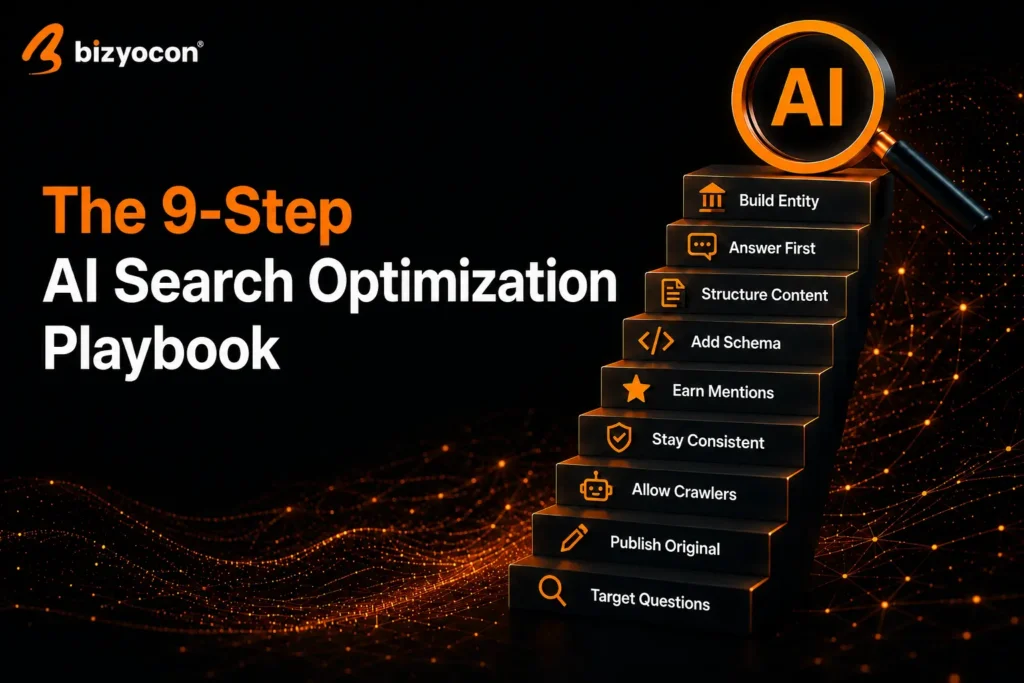
3. Structure content the way machines read it
Format is doing real work now. The patterns that get extracted most often:
• Question-based H2s that mirror how people actually ask (“How much does a 3D walkthrough cost?” beats “Pricing”)
• A 40-60 word direct answer immediately under each heading
• Comparison tables – models pull these almost verbatim
• Numbered steps for any process
• Short paragraphs, two to three sentences maximum
Long, conversational queries of eight or more words trigger AI Overviews far more often than short ones. That means your headings should be full questions, not keyword fragments.
4. Implement schema markup properly
Schema is how you hand a machine your facts without asking it to guess. At minimum, deploy:
| Schema type | Where it goes | What it tells AI |
| Organization | Homepage | Who you are, logo, social profiles |
| LocalBusiness | Contact and location pages | Where you operate, hours, service area |
| Service | Each service page | What you sell and to whom |
| FAQPage | Blogs and service pages | Question and answer pairs, ready to extract |
| Article | Every blog post | Author, date, topic |
| AggregateRating | Testimonial pages | Third-party validation |
Add a sameAs property linking to every profile you own. That single property is what connects your scattered listings into one entity in the machine’s eyes.
5. Earn third-party mentions
This is the hardest step and the highest leverage one. AI engines weight consensus, so being mentioned on sites you do not control matters more than anything you publish yourself.
Focus on industry listicles and roundups in your category, genuine trade publication coverage, verified directory profiles, review platforms such as Google, Clutch and industry-specific portals, and podcast or webinar appearances that produce a transcript.
One well-placed mention in a “top companies” article can carry more weight in an AI answer than a month of blog output.
6. Keep your facts consistent everywhere
Pick your canonical facts – founding year, cities served, service list, team size – and use identical wording for them across every property. When your website says “serving clients since 2016” and LinkedIn says 2018, an AI engine will usually avoid stating either.
7. Let the AI crawlers in
Many websites are invisible to AI search for a trivial reason: their robots.txt file blocks the bots. Check whether you are allowing GPTBot and OAI-SearchBot for ChatGPT, Google-Extended for Gemini grounding, PerplexityBot, ClaudeBot, and Bingbot, which still feeds several AI products.
Blocking these is a legitimate choice if you are protecting proprietary content. But do it deliberately – not because a plugin default made the decision for you.
8. Publish something only you could publish
Models are trained on the entire internet’s supply of generic advice. Recycled content gives them no reason to cite you specifically.
Original assets earn citations: pricing data from your own projects, survey results from your customers, documented case studies with real numbers, and process breakdowns from work you actually did. Our client success stories exist for exactly this reason – they contain facts that appear nowhere else on the internet.
9. Target conversational, long-tail questions
Traditional keyword research optimises for “digital marketing agency Ahmedabad”. AI-era research optimises for “which digital marketing agency in Ahmedabad is best for a manufacturing company with an export focus?”
Mine the real questions from your sales calls, WhatsApp enquiries, Google Search Console queries, and the “People also ask” boxes. Then build a page or a section that answers each one completely.
What not to do
A few mistakes actively cost businesses their AI visibility:
• Stuffing keywords into AI-generated filler. Models detect low-information content and skip it.
• Hiding key facts inside images or PDFs. If it is not selectable text, it is largely invisible.
• Publishing pages with no author and no date. Both are trust signals.
• Claiming superlatives with no proof. “India’s leading agency” with no third-party source is noise, and models discount it.
• Blocking crawlers by accident, then wondering why you are never mentioned.
How do you track whether it is working?
AI visibility does not appear in a rank tracker, so measure it three ways.
Prompt testing. Build a list of 20 to 30 questions a real buyer would ask, and run them monthly across ChatGPT, Gemini, Perplexity and Google AI Mode. Record whether you are mentioned, in what position, and which of your pages was cited. This is your baseline.
Referral traffic. In GA4, segment traffic from chatgpt.com, perplexity.ai, gemini.google.com and copilot.microsoft.com. Volumes are small but the intent is extremely high – these visitors already have a recommendation in hand.
Brand mention monitoring. Track how often your business name appears alongside your main competitors across the web. AI consensus is built from that pool.
Your first 30 days
| Week | Focus | Outcome |
| Week 1 | Audit robots.txt, fix name and address consistency across listings | Crawlers can reach you and see one identity |
| Week 2 | Deploy Organization, LocalBusiness, Service and FAQ schema | Your facts become machine-readable |
| Week 3 | Rewrite the top 5 pages with question headings and direct answers | Content becomes extractable |
| Week 4 | Run baseline prompt testing, set up GA4 AI referral segments | You can prove movement from here on |
Beyond day 30, the work becomes ongoing: publish original data, earn mentions, and re-test your prompts every month. This compounds slowly and then holds – much like content-led growth compared with paid channels, the early weeks look quiet and the later ones do not.
The bottom line
AI search has not made SEO obsolete. It has raised the standard. The businesses being recommended by ChatGPT, Gemini and Google AI Overviews are not the ones with the biggest budgets – they are the ones whose facts are consistent, structured, verifiable and confirmed by other people.
That is genuinely achievable for a mid-sized business. But it will not happen by accident, and every month you wait, a competitor becomes the default answer to a question you should be winning.
Frequently asked questions
1. How long does it take to get recommended by AI search engines?
Most businesses see their first citations within 8 to 12 weeks of consistent work. Technical fixes such as schema markup and crawler access can show results in 3 to 4 weeks, while entity building and third-party mentions typically take 3 to 6 months to compound.
2. Is AI search optimization different from traditional SEO?
They overlap but are not the same. Traditional SEO optimises for ranking positions and clicks. AI search optimization focuses on being extracted and cited inside an answer, which depends more on content structure, schema markup, factual consistency and third-party mentions than on backlink volume alone.
3. Should I block or allow AI crawlers?
Allow them if you want to be recommended. Blocking GPTBot, Google-Extended, PerplexityBot or ClaudeBot removes your site from the pool those engines draw on. Blocking only makes sense when you are deliberately protecting proprietary content.
4. Does schema markup really affect AI recommendations?
Yes. Schema converts your content into labelled facts rather than text a model has to interpret. Organization, LocalBusiness, Service and FAQPage schema, connected by a complete sameAs property, are the highest-impact types for most businesses.
5. Can a small business compete with large brands in AI search?
Often yes, and more easily than in traditional search. AI engines reward specificity and verifiability, not domain size. A small firm with precise service pages, real case-study data and consistent listings frequently outperforms a large generalist competitor on narrow, high-intent questions.
6. How do I know if my business is being mentioned by AI right now?
Ask the engines directly. Run 20 to 30 buyer questions through ChatGPT, Gemini, Perplexity and Google AI Mode, and record whether you appear and which page is cited. Repeat monthly and track the change. That is your AI visibility baseline.