When you stop SEO, your rankings usually hold for the first one to two months because earlier work is still paying off. After that, competitive keywords start slipping, content goes stale, backlinks decay and technical issues build up unnoticed. In most markets, the drop in organic traffic and leads becomes clearly visible within six to twelve months.
You spent months getting your website onto the first page of Google. The enquiries are coming in, the traffic graph is finally pointing up, and now a fair question comes up in a budget meeting: if the rankings are already there, why keep paying for SEO every month?
It is a question almost every business owner asks at some point, and the honest answer is not “everything collapses the moment you stop”. Rankings rarely disappear overnight. They slip, slowly at first and then faster, as competitors keep publishing, Google keeps updating, and your own website quietly ages. How quickly that happens depends on your industry, your competition and how strong your foundation was when you stopped.
This guide walks you through what actually happens after you stop SEO, month by month, what you keep and what you lose, and how to cut back on SEO spend without throwing away the results you already paid for.
Why Rankings Don’t Stay Put on Their Own
Search rankings are not a fixed position you buy once. They are a comparison. Google looks at every page competing for a keyword and decides which one answers the search best today, not which one answered it best last year. So even if your website stays exactly the same, your position can fall simply because someone else got better.
That is the main reason SEO is not a one-time investment. Your competitors are refreshing their content, earning new backlinks and improving page speed while you stand still. At the same time, Google rolls out core algorithm updates several times a year and keeps changing how search results look, with AI Overviews, local packs and “People also ask” boxes pushing plain blue links further down the page. If you want to understand how that shift affects visibility, our guide on GEO vs SEO explains it in detail.
Your own website also changes with time, even when nobody touches it. Statistics become outdated, product pages list old specifications, and the pages that once linked to you get deleted or redesigned. This slow loss of freshness and authority is often called content decay, and it is one of the quietest reasons rankings drop.
The Timeline: What Happens After You Stop SEO
There is no exact date on which rankings fall, but the pattern is fairly consistent across most websites. The early months feel safe, which is exactly why many businesses assume stopping SEO had no effect. The real impact shows up later, when it is harder and slower to reverse.
The table below shows the general pattern for a business in a moderately competitive market. Low-competition niches move slower, and crowded local markets move faster.
| Time After Stopping | What Usually Happens | What You Notice in Google Search Console |
| Month 1–2 | Rankings hold steady because past content, links and fixes are still working | Clicks and impressions look almost unchanged |
| Month 3–6 | Competitors overtake you on high-value keywords; new pages take longer to get indexed | Average position slips a few places on your main keywords |
| Month 6–12 | Organic traffic and enquiries drop visibly; unresolved technical errors start adding up | Impressions fall, click-through rate falls and top pages lose traffic |
| 12 months and beyond | Competitors own most of your former keywords; regaining them needs a full recovery effort | Traffic has dropped sharply from its peak and keeps falling |
The key point is the delay. Because SEO results lag behind the work, the effect of stopping also lags behind. By the time the drop is obvious in your lead numbers, you have usually lost several months of ground.
What You Keep vs. What You Lose
Stopping SEO does not wipe out everything. The work already done still has value, and some of it keeps helping your website for a long time. Earned backlinks from genuine industry websites, well-written evergreen content and a clean technical setup do not expire the day your contract ends.
What fades is anything that depends on being active. Rankings for competitive keywords, freshness signals and your visibility in the local map pack all need regular attention. You also stop gaining new ground, which means every new search trend, product or service you add goes unoptimized.
| What You Keep | What You Gradually Lose |
| Backlinks already earned from relevant websites | Positions on high-competition, high-value keywords |
| Evergreen pages that are already indexed | Freshness signals as content and data go out of date |
| Domain trust built over the years | Visibility in the Google local pack and on Maps |
| Branded searches from people who already know you | Coverage of new keywords, services and search trends |
| Technical fixes, until the next site update breaks them | Mentions and citations in AI Overviews and AI answers |
That last row matters more than it used to. AI-powered search tools prefer sources that are current, well-structured and frequently referenced. A website that stops publishing and updating tends to get cited less over time. Our guide on getting your business recommended in AI answers covers what those tools look for.
How Fast You Drop Depends on Your Industry
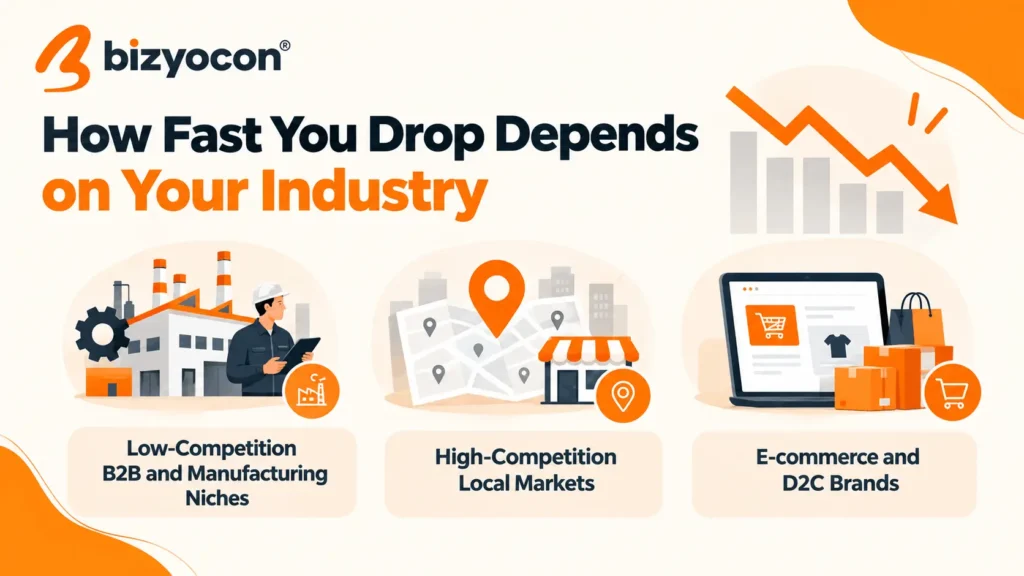
Two businesses can stop SEO in the same month and see completely different results. The biggest factor is how many competitors are actively fighting for the same searches, and how often those competitors update their websites.
Low-Competition B2B and Manufacturing Niches
Manufacturers of industrial equipment, engineering products or specialised machinery often compete with only a handful of websites for each product keyword. Many of those competitors do little SEO themselves. In these niches, rankings can hold for a long time after you stop, sometimes for many months. The risk here is not a sudden fall but missed growth, because new product keywords and export searches go unclaimed.
High-Competition Local Markets
Real estate, clinics, coaching institutes and home services are a different story, especially in a large city. In a market where dozens of businesses invest in local SEO for a competitive city like Ahmedabad, the local pack changes constantly. Competitors collect fresh reviews, post updates on their Google Business Profile and publish locality pages every month. A business that goes quiet can lose its map visibility within a few months.
E-commerce and D2C Brands
Online stores usually feel the drop fastest. Product and category pages compete on searches that change with seasons, prices and trends. Competitors add new product pages, refresh category content and build links constantly. When an e-commerce site stops SEO, stock changes create broken pages and duplicate URLs, which pull organic traffic down even faster.
The Hidden Risk: Technical Problems Nobody Is Watching
Most people think of SEO as content and backlinks, so they assume stopping SEO just means fewer blog posts. In reality, a large part of ongoing SEO work is monitoring. When that stops, problems that would normally be caught in a week can sit unnoticed for months.
Websites are not static. Themes get updated, plugins change, developers add new sections and hosting settings get modified. Any of these can break something that search engines depend on, and none of them send you a warning email. Some of the most common issues that appear after SEO work stops are:
• A plugin or theme update adds a “noindex” tag or blocks pages in robots.txt by mistake
• A website redesign changes URLs without proper 301 redirects, losing years of link value
• Page speed and Core Web Vitals get worse as new images, scripts and pop-ups are added
• Crawl errors, broken internal links and 404 pages pile up in Google Search Console
• Your Google Business Profile collects unanswered reviews or unwanted edits from other users
A single one of these problems can undo more ranking progress in a month than a year of slow decay. That is why the technical side is often the most expensive part to ignore.
Warning Signs Your Rankings Are Slipping
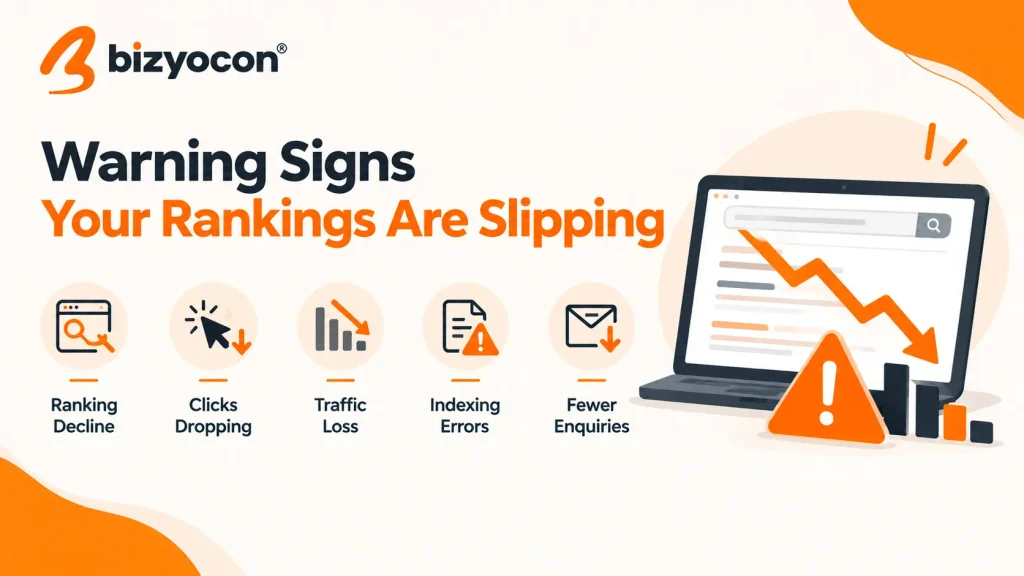
If you have already stopped SEO, or you have reduced it, you do not need to guess whether it is affecting you. The early signals show up in your data well before they show up in your sales numbers, as long as someone is looking.
Google Search Console is the most reliable place to start, because it shows how your website actually performs in Google search. Compare the last three months with the same period last year rather than with the previous month, so seasonal changes do not mislead you.
| Warning Sign | Where to Check It | What It Usually Means |
| Average position dropping month after month | Search Console, Performance report | Competitors are overtaking you on key searches |
| Impressions steady but clicks falling | Search Console, Performance report | Lower positions or AI Overviews taking clicks |
| Traffic falling on your top landing pages | Google Analytics, Landing pages report | Content decay on the pages that matter most |
| Rising “Not indexed” or error pages | Search Console, Pages report | A technical issue is blocking or confusing Google |
| Fewer calls and direction requests | Google Business Profile, Performance | Loss of visibility in the local pack |
Stopping vs. Pausing: A Smarter Way to Cut SEO Spend
If budget is the real reason you want to stop SEO, you have a better option than switching everything off. A reduced maintenance plan protects the rankings you already have while cutting out the most expensive, growth-focused work such as large content campaigns and new link building.
Think of it as the difference between switching off a machine and running it at low power. Maintenance mode keeps the website healthy, keeps your most valuable pages fresh and makes sure someone notices problems early. You give up fast growth for a while, but you do not give up the ground you already won.
| Maintenance Task | How Often | Why It Matters |
| Technical health check (indexing, errors, speed) | Monthly | Catches accidental noindex tags, broken redirects and crawl errors early |
| Refresh your top 10 traffic pages | Every quarter | Keeps facts, dates and examples current so the pages stay competitive |
| Google Business Profile posts and review replies | Weekly or fortnightly | Maintains local pack visibility and customer trust |
| Broken link and redirect monitoring | Monthly | Protects the link value your website has already earned |
| Keyword position tracking | Twice a month | Shows a slip early enough to act on it |
There is also a simple cost logic here. Getting rankings back after a long break usually takes more time and budget than keeping them would have, because you are now working against competitors who strengthened their position while you were away.
| Good to know: Before you pause, make sure you have full ownership of your Google Search Console, Google Analytics, Google Business Profile and hosting access. If an agency set them up, ask for admin access in writing so you can restart later without rebuilding your data from zero. |
When Stopping SEO Actually Makes Sense
SEO is not the right investment for every business at every stage, and it is worth being honest about that. If you are closing a product line, changing your business model or planning a complete rebrand on a new domain, continuing SEO on the old website may not be the best use of money.
Stopping can also make sense when your team is already fully booked and cannot handle more enquiries for the foreseeable future. In that case, a light maintenance plan is usually enough to protect what you have until capacity grows.
What does not justify stopping SEO is poor results from a single agency. If you have seen no clear reporting, no ranking movement and no explanation of what was done, the problem is usually the execution, not SEO itself. Switching to a partner with a transparent process is usually a better move than abandoning the channel completely.
How to Restart SEO If Your Rankings Have Already Dropped
The good news is that a website with past rankings is almost always easier to recover than a brand-new website is to grow. Google already knows your domain, many of your backlinks are still in place, and your old content gives you a strong starting point.
Recovery works best in a clear order, fixing the foundation before chasing new keywords:
• Run a full SEO audit: Find technical issues, indexing gaps and pages that lost the most traffic.
• Recover pages that used to rank: Update and expand the pages that dropped from the first page, since they have the fastest path back.
• Refresh outdated content: Update facts, examples, internal links and search intent across your key service and product pages.
• Rebuild authority steadily: Earn fresh, relevant backlinks and mentions instead of chasing volume.
Most businesses start seeing recovered positions on their older pages within a few months of consistent work. New keywords and fresh growth follow once the foundation is stable again.
Worried Your Rankings Are Slipping?
Whether you have already stopped SEO or you are thinking about cutting back, a clear audit shows exactly what needs protecting and what can wait. As an SEO company in Ahmedabad working with manufacturers, real estate firms, clinics and e-commerce brands, Bizyocon can review your rankings, technical health and lost traffic, then recommend a plan that fits your current budget. Book a free SEO audit today.
Contact UsFrequently Asked Questions
1. Will Google penalize my website if I stop doing SEO?
No. Google does not penalize websites for stopping SEO work. A penalty, or manual action, happens only when a website breaks Google’s spam policies, such as buying links or publishing auto-generated spam content. Stopping SEO simply means you stop improving, so any drop you see comes from competitors moving ahead and your website ageing, not from a penalty.
2. Can I switch SEO agencies without losing my rankings?
Yes, if the handover is managed properly. Make sure you own all accounts and content, get a list of the work done so far, including backlinks built and redirects set up, and avoid changing URLs or deleting pages during the switch. Rankings are tied to your website and domain, not to the agency, so a clean transition should not cause a drop.
3. Does stopping Google Ads affect my organic rankings?
No. Google Ads and organic rankings are separate systems, and paying for ads does not improve or protect your SEO positions. However, you may notice fewer total clicks and branded searches after stopping ads, because fewer people see your brand name in search results. That is a visibility effect, not a ranking change.
4. Can my in-house team handle basic SEO maintenance?
Partly. A team member can manage Google Business Profile posts, reply to reviews and keep an eye on Search Console alerts with a little training. Technical checks, redirect planning and content refreshes that target the right keywords usually need someone with SEO experience. Many businesses use a mix, with the in-house team handling routine tasks and a specialist reviewing the site monthly.